





KOCHI:
At the Kochi-Muziris Biennale (KMB), artist Dhiraj Rabha presents The Quiet Weight of Shadows (2025), a deeply immersive installation that excavates the long and fraught history of insurgency in Assam.
Rooted in years of documentary research and lived memory, the work navigates the uneasy terrain between state narratives, media power, and the intimate testimonies of those who once lived inside the conflict.
Rabha’s practice draws from installations, photography, film, and archival documentation to reflect on displacement, surveillance, and resilience in communities shaped by the insurgency of the United Liberation Front of Assam (ULFA). His point of departure is a former ULFA camp in Goalpara, both a real location and a symbolic site of containment, fear, and fractured belonging.
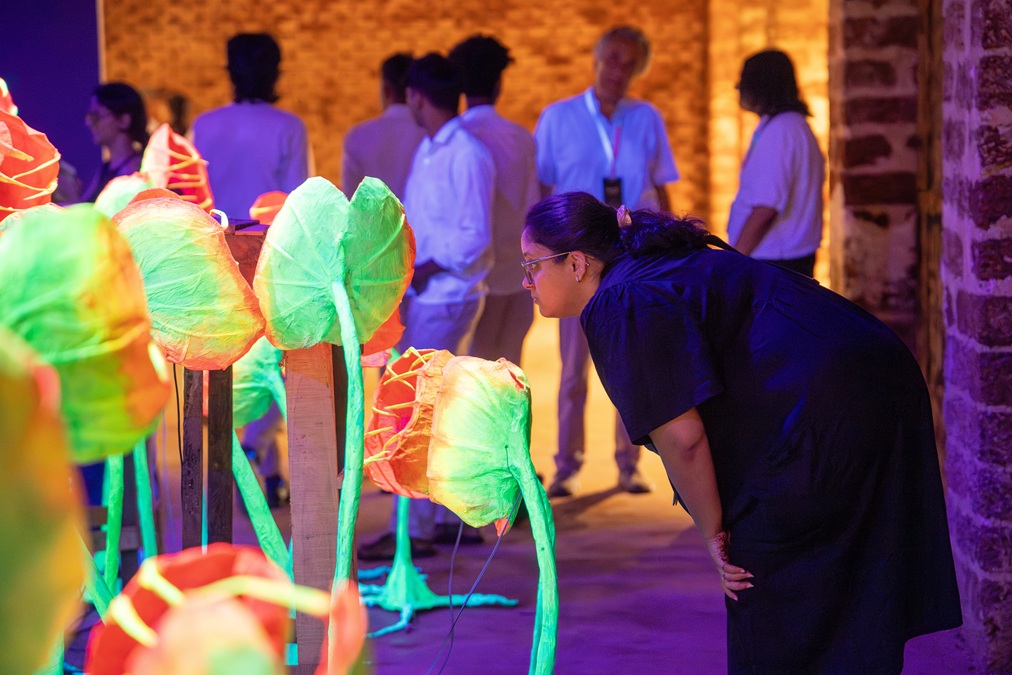
At the heart of the Biennale installation is a disconcerting garden of carnivorous plants glowing under blue UV light. Their sharp, white, tooth-like forms appear alluring from a distance, almost ornamental. But as viewers move closer, the beauty gives way to unease.
The plants emit overlapping news audio in Assamese, Hindi, and English, broadcasts from the 1990s to 2010 related to the ULFA movement. The voices dissolve into noise, swallowing meaning rather than clarifying it.
“The carnivorous plants represent power,” Rabha explains. “They represent the dominating news. It is actually about who holds power. News spreads from everywhere, and it consumes everything.”
This metaphor of consumption lies at the core of the work. The plants embody how media narratives devour complexity, flattening lived experiences into headlines. There is a deliberate duality in their form.
“From a distance, the flowers look beautiful,” Rabha says. “But when you come closer, there are layered stories inside. Videos are playing, voices are speaking. It looks different from far away, but closer, the contradictions appear.”
Surrounding the garden are eight watchtowers, modelled on surveillance structures commonly found in detention camps. From these elevated points, visitors look both into and outside the enclosure, mirroring the constant state of being watched. Inside each tower are video interviews with former ULFA members, who speak quietly and reflectively about loss, violence, fear, and their aspirations for themselves and their families. These testimonies stand in stark contrast to the aggressive noise of the news broadcasts below, creating a tension between lived memory and official record.
In an adjoining space, Rabha reconstructs the image of a burnt house. Scattered within it are fragments of real archival materials, newspapers, books, pamphlets, and documents related to the ULFA movement and student protests from the 1990s. While the structure itself is a recreation, the materials are authentic. “These are real documents,” Rabha clarifies. “The house is a representation, but the archives are real. Burnt houses were common during that time, from the 1990s to around 2010.”
Photographs displayed here depict everyday life in camps: training sessions, weddings, soldiers, and fleeting domestic moments. Many details are damaged or lost, echoing how memory itself erodes under prolonged violence.
The installation also includes Rabha’s film Whispers Beneath the Ashes (2025), a poetic and surreal work that departs from linear storytelling. It follows a group of children wandering through a forest, encountering mysterious figures as they search for a sense of home, an allegory for generations growing up amid instability and inherited trauma.
Although Rabha’s research is heavily documentary, his curatorial choice is to resist presenting it as an archive-heavy exhibition. “There is a lot of data, a lot of documents,” he says. “But I didn’t want to present it in a straightforward exhibition format. This time, I wanted to work in a surreal way.”
That surreal quality permeates the entire installation, where beauty masks threat, sound overwhelms sense, and memory exists in fragments rather than facts. The Quiet Weight of Shadows does not offer closure or verdicts. Instead, it asks viewers to sit with discomfort, to question whose voices are amplified and whose are swallowed, and to recognise how power often hides behind aesthetics.
In doing so, the artist transforms a history of insurgency into an experiential landscape, one where silence, surveillance, and storytelling coexist, and where the weight of the past continues to cast long, quiet shadows.


more recommended stories

KOCHI:A quiet but devastating story of.

KOCHI:Each handmade Manchaha (from the heart).

KOCHI:The current assessment of Kochi’s vulnerability.

KOCHI:Former Lok Sabha member Subhashini Ali.

KOCHI:The Students’ Biennale at St Andrew’s.

KOCHI:A three-day Terracotta & Wheel Pottery.

KOCHI:A four-day ‘Soil Assembly’ conference began.

NEW DELHI:Showcasing Kerala as an experiential.

KOCHI:On entering the room, the viewer.

KOCHI:Thai visual artist and documentary filmmaker.
