





KOCHI:
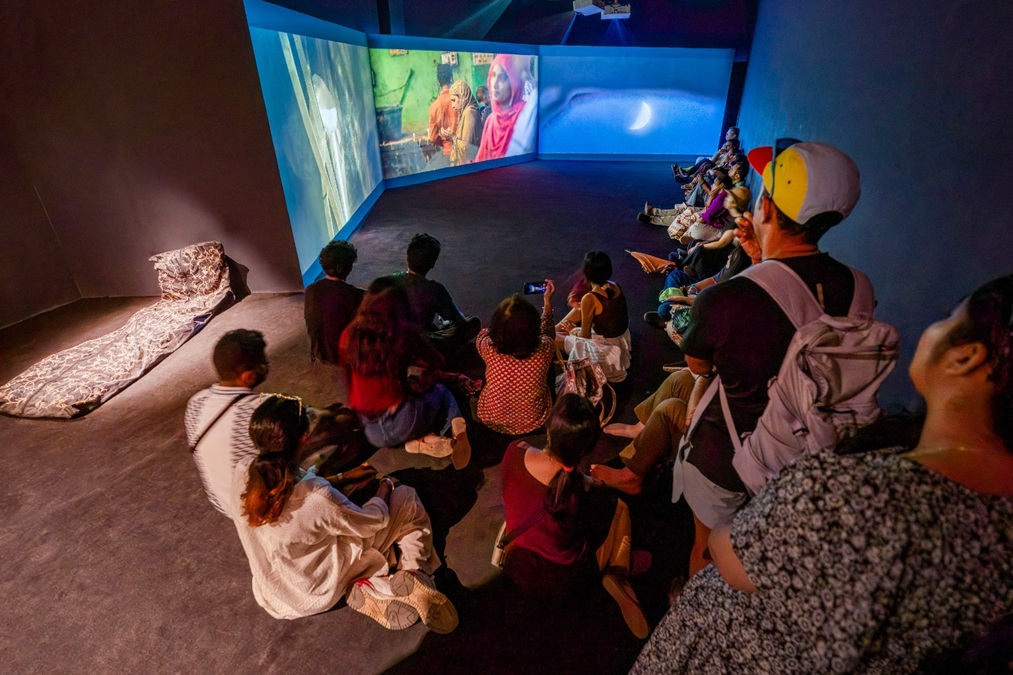
At the Kochi-Muziris Biennale, Pallavi Paul’s Alaq unfolds as a three-channel cinematic installation. It does not announce itself loudly, nor does it offer the comfort of easy narratives. Instead, it asks the viewer to slow down, to stay, and to listen; to grief, to memory, to care, and to the fragile systems that hold life together in moments of collective crisis.
Paul, a New Delhi-based visual artist and film scholar, has long worked with themes of loss, vulnerability, and the politics of care.
“My work for over a decade now has been concerned not only with grief and loss, but with political agency, resilience, and a sustained questioning of the structures that produce vulnerability and violence,” she says.
In Alaq (2025), these concerns take shape through a journey across Kerala: between hospital wards and shrines, between medical science and spiritual belief, between frontline workers and those they serve. The work draws from testimonies of doctors, nurses, caregivers, and local communities shaped by recurring outbreaks of zoonotic disease, particularly the Nipah virus, as well as from the shrine of Beema Bevi, a revered female saint figure associated with healing across religious boundaries.
Rather than treating contagion as a sensational event, Alaq treats it as a condition, something that lingers in bodies, memories, landscapes and relationships long after the crisis has passed.
“Alaq brings together testimony, mythology, and medical realities to think about
vulnerability not as an exception, but as a shared condition shaped by history, labour, and belief," she explains.
The dead, in this work, are not absent. They remain present through memory, ritual, testimony and care.
Across its three screens, Alaq weaves together microscopic imagery of viral matter, archival fragments, slow observational footage and intimate portraits of care. Hospital protocols sit alongside prayers; scientific instruments alongside devotional gestures. The effect is not to blur science and faith into sentimentality, but to show how, in moments of uncertainty, both often function as systems of hope, discipline and responsibility.
Crucially, Paul’s approach resists the visual language that one tends to associate with crisis. There are no dramatic crescendos, no intrusive close-ups of suffering, no aestheticized trauma.
“Refusing spectacle was a methodological and artistic choice, against speed, extraction, and aesthetic comfort," says Paul, who works chiefly with video and installation. “We worked only by invitation, through local trust, and did not film people even if there was the slightest hesitation," she adds. “This refusal of spectacle is not merely ethical; it is artistic.”
At forty minutes, the film asks something unusual of today’s viewer: patience. “The film’s duration of 40 minutes asks the viewer to stay, to listen, and to bear time alongside testimony rather than consume it,” she states. It asks viewers not to consume testimony, but to sit with it; to bear time alongside those who speak.
“For me, aesthetics are not a veil over suffering, but a way to shift responsibility away from the afflicted and toward the systems that shape their exposure," says the artist.
Grief in Alaq is never just emotional; it is social and political. The work does not ask viewers to feel sorry for its subjects, rather recognise them as agents navigating difficult conditions with dignity and imagination.
The work insists on listening slowly, and on recognising frontline workers, architects, patron saints and the possessed not as symbols of sacrifice, but as agents navigating, and imaginatively resisting, structural asymmetries.
The installation is accompanied by sculptural and print works that extend this atmosphere of quiet tension. Anasir (2025), a series of collagraph prints developed with Digvijaysinh Jadeja,
embeds traces of images into paper through embossing and etching. Trousseau (2025) reworks medical body bags with embroidery, transforming instruments of death into objects of care and ritual.
At a time when both public health and belief systems are increasingly instrumentalised, turned into tools of control, spectacle or profit, Alaq offers a different proposition. According to her, the film "resists binaries between science and faith, showing instead how care often emerges across religious and social boundaries.”
In doing so, Paul’s Alaq becomes less a film about disease, and more a meditation on what it means to live together in uncertainty: how care emerges, how responsibility circulates, and how survival, uneven as it is, is always collective.


more recommended stories

KOCHI:A quiet but devastating story of.

KOCHI:Each handmade Manchaha (from the heart).

KOCHI:The current assessment of Kochi’s vulnerability.

KOCHI:Former Lok Sabha member Subhashini Ali.

KOCHI:The Students’ Biennale at St Andrew’s.

KOCHI:A three-day Terracotta & Wheel Pottery.

KOCHI:A four-day ‘Soil Assembly’ conference began.

NEW DELHI:Showcasing Kerala as an experiential.

KOCHI:On entering the room, the viewer.

KOCHI:Thai visual artist and documentary filmmaker.
