





NEW DELHI:
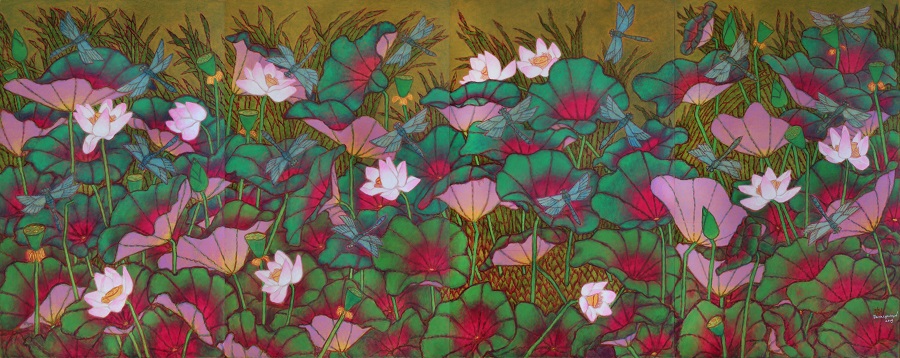
When Covid-19 began its deadly spread for weeks and months in his city, Delhiite A. Ramachandran thought he would work further on his famed series of paintings. Even as the basic intention was to distract himself from the horrors around the pandemic, the newest additions to the ‘Lotus Pond’ began gaining nuances like never before.
“The sentimentalism largely disappeared. Earlier they revelledin lyrical beauty. This time, in harsh situations, the images started becoming much denser,” the 86-year-old artist says. “I don’t plan a definite thought process or try to stick to it deliberately.Rather, I let my style express its natural way.”
Thus, three-and-a-half decades after Ramachandran first came up with his lotus-related images, the celebrated body of work went on to find fresh images last year. The most recent of them are colourful as always, but thematically more intrinsic. A select few of them are on display in the national capital currently. Vadehra Art Gallery (VAG)has organised the show titled ‘Subaltern Nayikas and Lotus Pond’ at its two-storeyspace in Defence Colony.
“In this case, there is a sort of forceful expression in my lotuses and the ponds. For, I had decided to spent more time than usual in my studio for days together…to keep my mind off the stories around the coronavirus,” points out the Padma Bhushan awardee, who was born in Kerala and formally trained in art at Santiniketan founded by Nobel laureate Rabindranath Tagore.“The flowers have become less delicate — the stalks are often stark. The water-bodies show more living beings…birds, insects…. They are a broader take on ecology.”
All the same, the updatesto the Lotus Pond series retain the original spirit of meditativeness. As art historian R. Siva Kumar says, the modern urban-dweller lacks time and patience to see nature in action and know it intimately. “Ramachandran achieves this in his ‘Lotus Ponds’. Like everything else innature, the lotus pond too does not reveal itself in an instant,” notes the professor, who teaches art at Santiniketan.
Ramachandran, who has been living in Delhi since the mid-1960s after his studies atVisva-Bharati University in West Bengal, said the news around Covid-19 put him under “tremendous mental pressure” amid loss of lives of near and dear.“I thought I should try to isolate myself from not just from the happenings around. Call it escapism, my daily engagement with the brush and canvas became longer and more intense than usual from early 2020,” he recalls. “That doesn’t mean I sought to translate my woes into pictures. Far from it, I chose to distance myself from the hard realities around.”
Prof Siva Kumar observes that ‘Lotus Pond’ explores the motif as an ecosystem in conversation with the elements of the world. “A painter of nature is not only defined by his distinct way of looking but also by his distinct way of transcribing what he sees,” he says. “How one looks, what one grasps, and how one transcribes what is experienced in space and time onto the canvas can be as different as the fleeting moment is from the long duration.”
Transcending time, Ramachandran’s show at VAG’s Modern Gallery till December 12 also features the Ashtanayikas — another set of pandemic-time paintings. They essentially reimagine the emotions of the love-struck heroines mentioned in the ancient Natya Shastra treatise on dramaturgy, but expressing them through Rajasthan’s Bhil tribal women who have been integral to Ramachandran’s aesthetics since the mid-1980s.
The ongoing show at VAG’s gallery is part of a twin exhibition. The other one was held last month simultaneously at Shridharani Gallery of Triveni Kala Sangam on Tansen Marg (Mandi House) for 17 days, also titled ‘Subaltern Nayikas and Lotus Pond’.
Ramachandran, who is a native of southern Kerala’s Attingal near Thiruvananthapuram, did his Masters in Malayalam literature before leaving for Santiniketan in 1957 to enroll as a student. He has been a Delhiite since the mid-1960s, having taught at JamiaMilliaIslamia. Ramachandranis also a winner of prestigious honours such as the KalidasSamman and Raja Ravi Varma Puraskaram.


more recommended stories

KOCHI:An all-female dance premiere that unfolded.

KOCHI:A quiet but devastating story of.

KOCHI:Each handmade Manchaha (from the heart).

KOCHI:The current assessment of Kochi’s vulnerability.

KOCHI:Former Lok Sabha member Subhashini Ali.

KOCHI:The Students’ Biennale at St Andrew’s.

KOCHI:A three-day Terracotta & Wheel Pottery.

KOCHI:A four-day ‘Soil Assembly’ conference began.

NEW DELHI:Showcasing Kerala as an experiential.

KOCHI:On entering the room, the viewer.
