





KOCHI:
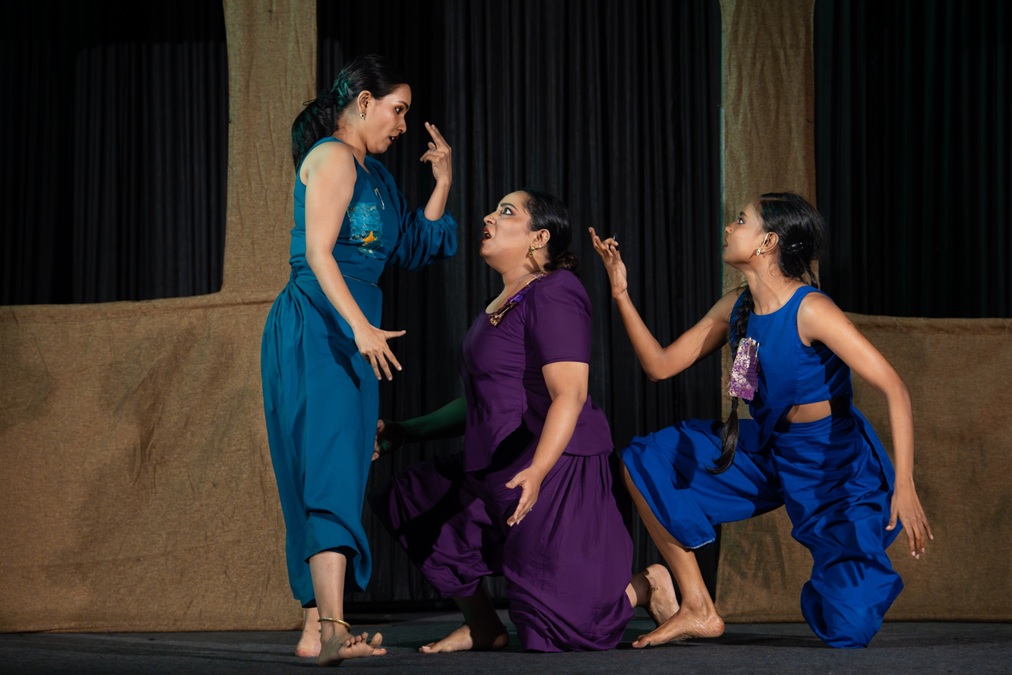
An all-female dance premiere that unfolded at the Pavilion, Bastion Bungalow, did more than mark a debut. It staked a claim. Gossip, the first full-length production by Thudippu Dance Foundation, Kochi, arrived as a confident, politically lucid performance at the Kochi-Muziris Biennale, transforming an everyday, often-dismissed word into a site of resistance, intimacy, and embodied knowledge.
Performed by Greeshma Narendran, Anjali Krishnadas, and Ponnu Sanjeev, Gossip is rooted in female friendship and resilience, but it refuses sentimentality. Instead, the work moves through tension, friction, humour, and vulnerability, drawing the audience into what might be described as a living conversation between three women navigating a patriarchal world together.
The packed venue and sustained applause signalled not only appreciation, but recognition, lending confidence and momentum to the group’s maiden performance last evening.
This premiere also marked an important moment for Thudippu Dance Foundation, a collective steadily gaining attention for its commitment to feminist practice, pedagogy, and performance. With Gossip, the foundation announced itself with clarity: this is work that listens to bodies, honours difference, and speaks back to dominant ideas of beauty, discipline, and respectability in Indian dance.
At the heart of Gossip is the body as archive. The dancers’ movements oscillate between the codified and the instinctive, between classical training and everyday gesture. The choreography resists clean lines and predictable symmetry. Instead, it leans into pauses, glances, shared weight, sudden collapses and recoveries. Laughter appears, then disappears. A whisper becomes a collective pulse. What emerges is not a linear narrative, but a shared terrain of lived experience.
“Our choreography is a natural dialogue between our different backgrounds in contemporary dance, Mohiniyattam, and Bharatanatyam,” said Anjali, one of the three dancers, speaking after the performance.
“Rather than sticking strictly to one style, we used these forms as a foundation to explore how our bodies move in everyday life. Since Greeshma, Anjali, and Ponnu each carry different training, we pushed ourselves to step outside our comfort zones. By using our bodies, we wanted to show the lived realities of women. The music also played a vital role, helping us transform these physical movements into a story about how three female friends navigate the world together,” she explained.
That navigation is neither abstract nor decorative. The dancers’ bodies are presented as distinctly different, not smoothed into a uniform aesthetic. Height, build, rhythm, and physicality are foregrounded rather than concealed. This choice is deliberate and political.
“This performance is an active effort to break the physical restrictions that society often places on women’s bodies,” Anjali pointed out. “We chose to highlight our three distinct body types to challenge ideas of perfection and beauty standards, proving that everybody deserves to move freely.”
Costume, too, becomes part of this argument. Brocade fabrics, secured with visible safety pins, move and shift with the dancers. The effect is striking: elegance held together by practicality. It gestures towards the daily negotiations Indian women make between labour, mobility, and appearance.
“Our costumes reflect this too,” Anjali added. “By using safety pins to secure brocade fabrics, we honoured the practical, daily reality of Indian women who have to move and work while navigating this world.”
Perhaps the most resonant intervention of Gossip lies in its reclamation of the very word it is titled after. In popular and patriarchal discourse, gossip is framed as frivolous, malicious, or idle, often used to trivialise women’s conversations and communities. Thudippu’s performance turns that assumption inside out.
“We are reclaiming the idea of ‘Gossip’,” said Anjali. “While the world often mocks women’s talk as something trivial, we show that these ‘third spaces’ are actually important. For us, gossip is a way to share knowledge, find support, and quite literally save each other’s lives in a patriarchal world.”
On stage, this reclamation unfolds through shared gestures, murmured exchanges, and moments where the dancers cluster together, forming temporary shelters with their bodies. The work suggests that survival often happens not in grand gestures, but in small, repeated acts of care and communication.
Underlying the entire performance is a deep sense of inheritance. The dancers’ movements feel weighted with memory, not just personal, but collective. There is a sense that what is being expressed has travelled through generations of women, stored and carried in muscle and breath.
“We believe that our bodies store the history of our ancestors,” Anjali reflected, “and the body can speak for ourselves, and our communities.” In the context of the Kochi-Muziris Biennale, Gossip stood out for its refusal to over-explain itself. It trusted the audience to sit with ambiguity, discomfort, and recognition. The Pavilion at Bastion Bungalow, with its open, resonant space, amplified the intimacy of the work, allowing the dancers’ breath, footfalls, and silences to register fully.


more recommended stories

KOCHI:A quiet but devastating story of.

KOCHI:Each handmade Manchaha (from the heart).

KOCHI:The current assessment of Kochi’s vulnerability.

KOCHI:Former Lok Sabha member Subhashini Ali.

KOCHI:The Students’ Biennale at St Andrew’s.

KOCHI:A three-day Terracotta & Wheel Pottery.

KOCHI:A four-day ‘Soil Assembly’ conference began.

NEW DELHI:Showcasing Kerala as an experiential.

KOCHI:On entering the room, the viewer.

KOCHI:Thai visual artist and documentary filmmaker.
