





KOCHI:
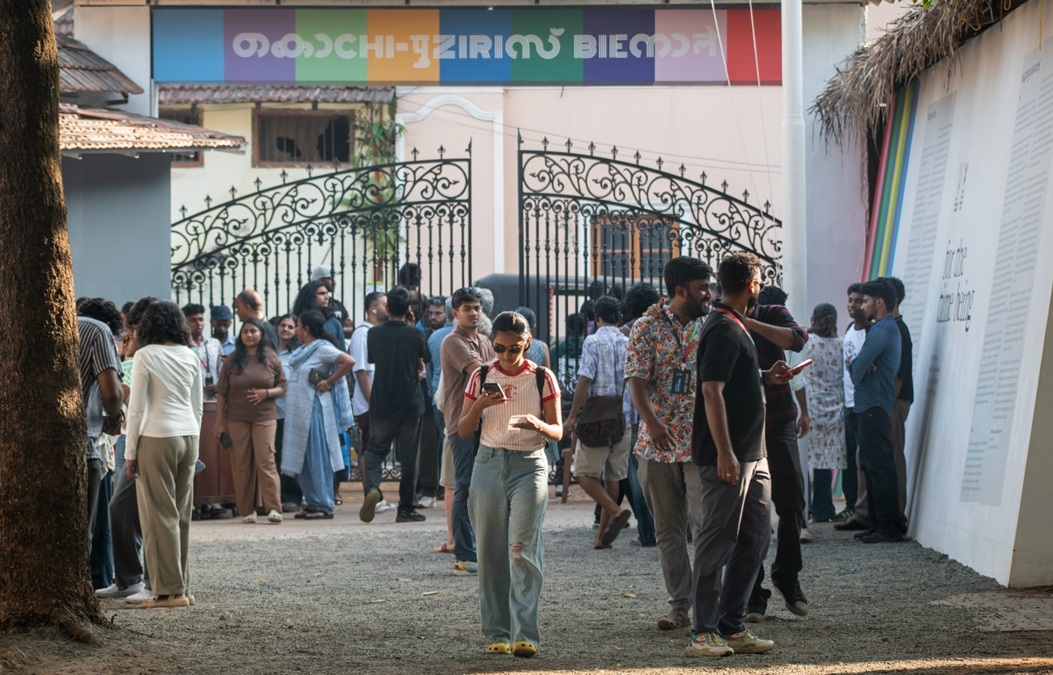
While much of the city lingered over Christmas lunches and afternoon siestas, the old colonial godowns of Aspinwall House told a different story on Thursday. Streams of visitors, families, students, tourists and art lovers, continued to flow into the Kochi-Muziris Biennale, turning the heritage waterfront into a living, breathing space of reflection, curiosity and quiet wonder.
The Biennale, now woven into Kochi’s cultural calendar as firmly as the monsoon and Christmas itself, became an alternative form of celebration for many, a place to pause, to contemplate, and to feel.
Adding to the day’s significance was the visit of Mr Harikishore S, Joint Secretary, Ministry of Tourism, Government of India, who spent time at the Aspinwall venue engaging with curators and viewing several installations. His presence underscored the Biennale’s growing stature not only as an art event, but as a cultural and tourism landmark with global resonance.
Among the many visitors was actor Madhupal, who emerged visibly moved after his walk through the exhibition spaces.
“One cannot finish seeing the Biennale in a single day. I need to come back again to see the Biennale,” he said, smiling. “Sheba Chhachhi’s video installation is very haunting and it touched me deeply. The works have multiple layers and deep meanings to understand.”
His words echoed the sentiment shared by many visitors who found themselves lingering longer than planned, allowing the layers of meaning to unfold slowly.
Inside the warehouses, light spilled across walls, video projections flickered like distant memories, and installations invited not just viewing but contemplation, each visitor carrying away a slightly different Biennale within them.
On a day associated with festivity, excess and noise, the Biennale offered something gentler: attentiveness, introspection, and shared silence.
As evening approached, the crowds did not dwindle. Instead, the slow, steady rhythm of footsteps through Aspinwall continued, a reminder that in Kochi, art has become not an interruption to life, but a way of inhabiting it.
On this Christmas Day, the Kochi-Muziris Biennale did not compete with the season; it quietly became part of it.


more recommended stories

KOCHI:Algerian artist Kader Attia has opined.

KOCHI:Paul Thoppil, Canada’s High Commissioner to.

KOCHI:It’s all in the gaze in.

KOCHI:At the newest edition of the.

KOCHI:Meenu James’ paintings transcend the confines.

KOCHI:At the Kochi-Muziris Biennale (KMB), artist.

KOCHI:The KMB Pavilion, described as the.

KOCHI:Moulds without a name are discarded.

KOCHI:Seeking to kindle the interest of.

KOCHI:As the 6th edition of Kochi-Muziris.
