





THIRUVANANTHAPURAM:
Nobel laureate Economist Prof Joseph E Stiglitz today said that the factors that have contributed to Kerala’s success are “competent Govt institutions, competent administration, participatory democracy and decentralisation, a reliance on Science and the continued importance given to planning “and advised Kerala to reduce its dependence on remittances from the Gulf countries as the world was moving away from oil and started using renewable energy sources as part of the efforts to deal with global warming.
Delivering the Keynote Address at “Kerala Looks Ahead,” a global virtual conference organised by the Kerala State Planning Board, he emphasised the importance of planning by arguing that “markets are short-sighted”, and “that’s why need Government leadership working with the private sector and civil society” to address future challenges. It is important for Kerala therefore to formulate its own economic strategy. Two key principles for Kerala are “diversification” and “building on current strengths”, he added.
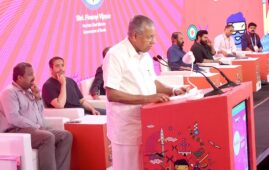
Chief Minister Pinarayi Vijayan inaugurated the three-day conference in which ministers E Chandrasekharan, Ramachandran Kadannappally, A K Saseendran, K Krishnankutty, Planning Board Vice-Chairman Prof V K Ramachandran, Chief Secretary Dr. Vishwas Mehta, and Planning Board Member-Secretary Dr Venu V, also spoke.
Prof Stiglitz said : “Kerala needs to work ahead as by 2050 the world will be largely dependent on renewable energy. It is imperative for Kerala to think ahead and create more jobs within the state. It cannot be dependent on remittances,” he said. “Kerala should strengthen its own productive capacity and generate employment in diverse areas within the state”, he added.
The noted economist said the Covid-19 pandemic would change the global economy, necessitating drastic changes in international trade and in governance and local administration.
The pandemic had brought to the fore the importance of international cooperation for dealing with such situations and other challenges like global warming and, at the same time, highlighted the need for being self-reliant in the production of essential items.
Lauding the Kerala government for its governance model of giving importance to health and education and five-year planning, he said the state had also handled the pandemic situation efficiently.
In her keynote address, Dr Soumya Swaminathan, Chief Scientist at the World Health Organisation (WHO), noted that health outcomes in Kerala were “comparable to the highest in the world”, and that “recent data from NFHS-5 showed progress in many indicators such as IMR and MMR”.
Observing that COVID pandemic has taught us the importance of investing in public health, Dr Soumya charted out a three-pronged strategy for the state to deal with its health issues. “In Kerala, there are pockets of under development, pockets of poverty and pockets where there are highly vulnerable people whose health outcomes are far worse than the rest of the population. This has to be addressed. The second is sustainability; anything we do would need to be sustainable. And the third is resilience in the face of health shocks that come from time to time.”
Kerala has had an experience with NIPAH which was handled excellently and actually the outbreak was contained and controlled, with minimal impact and loss of lives. “The COVID pandemic, however, has overtaken the capacity of the best health systems in the world. Therefore, this is a good time to identify where policies could be improved and also the gaps in human resources and institutional capacity,” she said
Observing that the pandemic has brought to the fore the accelerated use of digital tools and technology, she made a strong case for using tele-medicine on a wider scale. “We have a shortage of specialists, and in order to reach more people with specialist care, the use of tele-medicine is a very good option.”
Inaugurating the Conference, Chief Minister Vijayan said it was important to look forward to best ideas and practices that will help transform Kerala into progressive and modern economy that serves the interests of every citizen.
He said: “We need to think collectively on ways to move forward. We look forward to ideas that will help transform Kerala into a true knowledge economy founded on new technologies and innovation.”


more recommended stories

KOCHI: Museums and art galleries are.

KOCHI: The first International Spice Routes.
KOCHI:Revisiting the fabled Spice Route that.
KOCHI:The three-day International Spice Routes Conference.
THIRUVANANTHAPURAM:Declaration of the Spice Routes Heritage.

KOZHIKODE:Senior Congress leader and state unit.

KOCHI:The first international Spice Route Conference.

THIRUVANANTHAPURAM:Kerala received Travel + Leisure India’s.
THIRUVANANTHAPURAM:Asserting that Kerala’s moment has come.
KOLLAM:The Sabarimala gold heist investigation took.
