





KOCHI:
Long before the glacial lake burst the banks of Teesta dam in October 2023, long before the concrete walls at Chungthang crumbled in minutes under the weight of water and debris, the ecology of North Sikkim had already been re-engineered, compressed, and unsettled. Rivers were forced into tunnels, mountains hollowed out, and dust settled in slow, daily layers over villages that had once measured time by seasons rather than shifts.
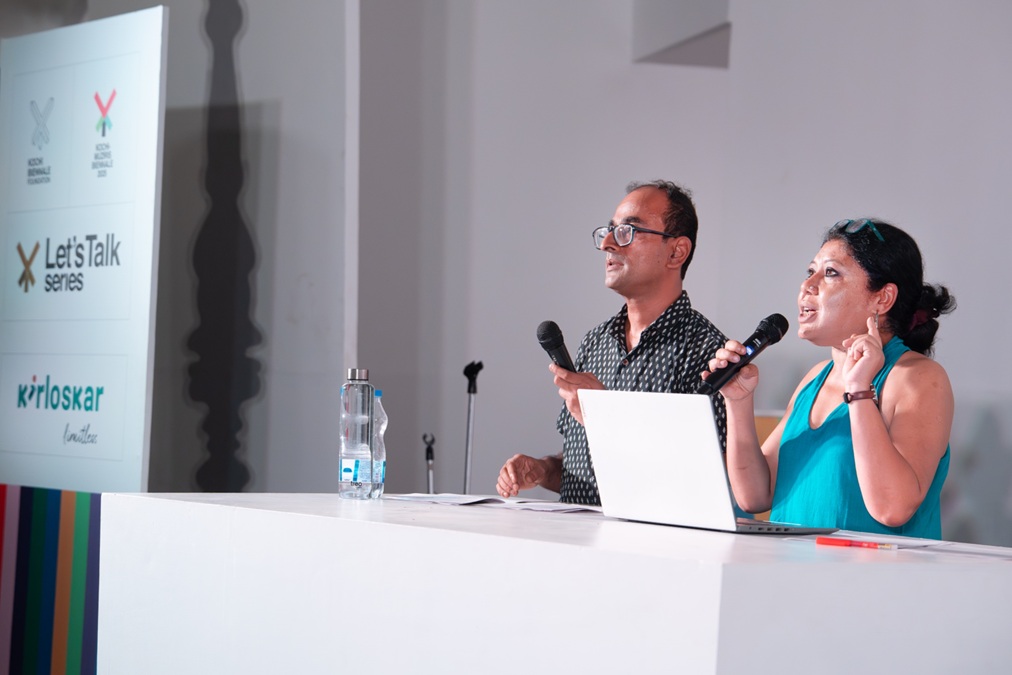
This uneasy transformation formed the emotional and political core of “Alibi in North Sikkim”, a talk delivered by documentary filmmakers Ruchika Negi and Amit Mahanti held at Bastion Bungalow as part of the ongoing Kochi-Muziris Biennale (KMB).
The session unfolded not as a lecture but as a reckoning. Interspersed with glimpses from their documentary, Negi and Mahanti traced the years leading up to and following the construction of a major hydroelectric dam in 2017, situating it within a wider push that has seen at least 27 hydroelectric projects planned or underway across Sikkim.
What emerged was not a binary argument for or against development, but a clarion call for the protection of a fragile Himalayan ecosystem.
The dam, as the filmmakers showed, did not merely alter a river’s course. It altered social rhythms and economic choices. Traditional farming practices, once central to local sustenance and identity, were gradually abandoned as dam-linked contractors’ jobs and daily wage labour promised quicker returns. Free electricity had been promised as a justification, alongside visions of progress and prosperity.
The arrival of the dam split Chungthang, a small town, physically and emotionally. For many residents, dreams of tourism, infrastructure, and a future that might finally retain younger generations took hold.
Yet this optimism existed alongside deep unease. Conversations captured in the film reveal a population weighing gains against losses without clear answers, as the environmental consequences became harder to ignore. Mountains were drilled through, destabilising slopes. Rivers, once visible markers of continuity, disappeared into tunnels. What lingered was a foreboding sense that nothing might ever be as it was again.
On the night of 4th October 2023, heavy rains triggered a breach in the South Lhonak glacial lake, and the resulting outburst flood swept down the Teesta valley to Chungthang, destroying the Teesta III dam, exposing the stark vulnerability of infrastructure in a volatile Himalayan landscape.
For Negi and Mahanti, the disaster did not come as a surprise so much as a grim confirmation of long-ignored warnings. Their documentary, developed over nearly 15 years of intermittent engagement with the region, documents what Negi described as a kind of micro-study of transitions.
“It’s kind of interesting for us to look at, over 15, 16 years, almost a substantial period, to see these transitions that have happened,” she said. The project, she added, was an attempt to open up what the place has become, rather than freeze it at a single moment of crisis.
What troubled both filmmakers most, however, was the response to the flood. Even as communities counted their losses and ecologists pointed to the intensive dam-building, government plans began to circulate about rebuilding a “better dam”. Rebuilding, in this context, threatens to repeat the same logic that treated rivers and mountains as manageable variables rather than living systems.
‘Alibi in North Sikkim’ does not offer a neat moral resolution. Instead, it insists on sitting with contradiction: the hope for opportunity alongside the grief for irreversible change, the allure of progress alongside the evidence of fragility.
As Sikkim and other Himalayan regions face accelerating climate risks, the questions raised by Negi and Mahanti extend far beyond one dam or one disaster. Who gets to define development, and at what cost? How do promises of electricity and employment weigh against the slow erosion of ecological and social foundations?
In the dust that once settled over North Sikkim and the floodwaters that later erased concrete certainties, the documentary arrives at its most unsettling insight: there are no clear answers, only the lingering sense that decisions taken in the name of progress will continue to mould lives and landscapes long into the future.
There were also talks by socio-cultural anthropologist Sara Shneiderman, who presented an ethnographic lecture titled Storytelling Across the Himalaya: Movement, Memory and Adaptation Between Nepali, Indian and Tibetan Worlds, and by Dhrubhajit Sarma of the ANGA Art Collective.


more recommended stories

KOCHI:The art presentation ‘Sweet Ascent –.

KOCHI:The 10th edition of Photo Brussels.

KOCHI:The Kochi Biennale Foundation (KBF) will.

KOCHI: At the Arthshila venue of.

KOCHI: Riaz Hamidullah, High Commissioner of.

KOCHI: How about making celluloid as.

KOCHI: An illustration workshop, titled The Inner.

THRISSUR: A two-day seminar exploring the.

THRISSUR: Dr R Bindu, Kerala’s minister.

THRISSUR: Writer and critic Sunil P.
