





KOCHI:
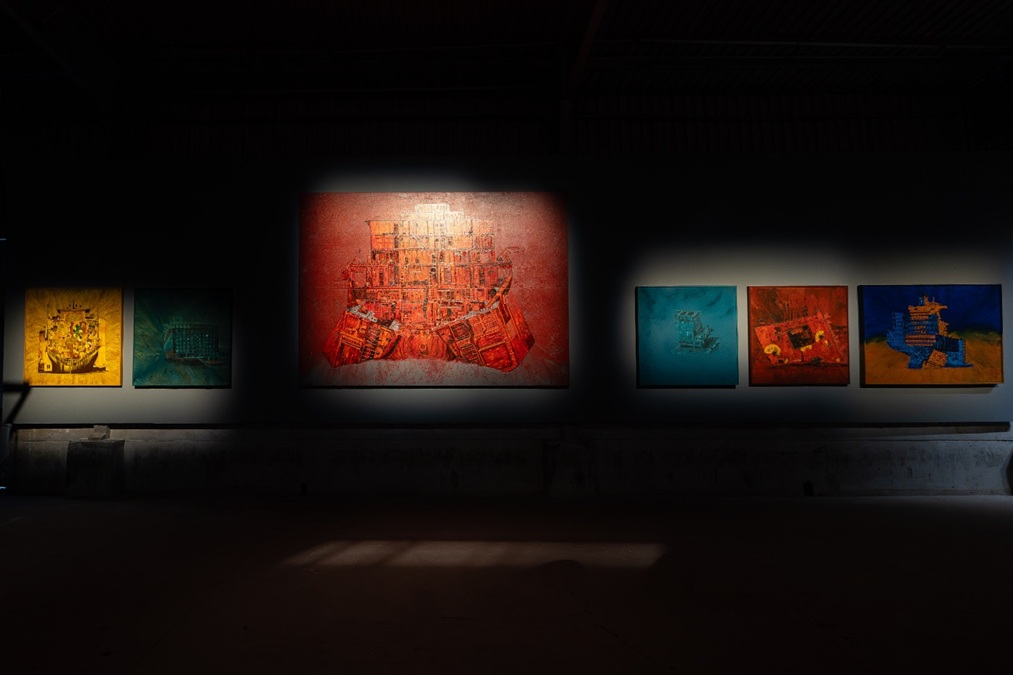
At first glance, Himanshu Jamod’s large painting may bring to mind a dark-coloured building. However, it quickly becomes evident that it depicts a ship that has split in half.
The artist, who hails from Bhavnagar, has captured the final journey of a ship many have known since childhood through drawings and sketches.
This art installation is currently being exhibited at the Willingdon Island Warehouse, one of the venues for the sixth edition of the Kochi Muziris Biennale.
Alang, in Gujarat, is often referred to as the graveyard of ships, as hundreds of old, unusable vessels are brought here for dismantling. Himanshu’s family is involved in this business, and he has observed ship dismantling since his childhood.
He notes that few people consider what a ship cut in half truly looks like—it resembles a multi-story building.
Himanshu emphasises that this industry provides livelihood and shelter to many families across India, highlighting the human aspect he aims to share through his art.
He points out that while the ship dismantling centre in Gujarat often makes headlines for environmental concerns, the other side of the story remains unseen.
Many workers, not just Gujaratis, come from various parts of the country to make a living in this profession. Himanshu stresses that this illustrates the necessity of survival.
The dismantled materials are recycled, providing good-quality steel at a low cost within the country. He refers to this process as a circular recycling of metal waste.
Himanshu explains that the size of his paintings is influenced by the sights he encounters daily, and he uses similar colours to reflect this. The intense colours—yellow, sea green, red, and blue—along with the large scale of his artwork, emphasise the significance of the themes he explores.
His collection of paintings titled “Retrieve” and Seedbed have been developed in a series since 2016 and is featured in this exhibition.
In his work, Himanshu transforms the image of a wrecked ship into a striking temporary housing complex. This innovative structure serves as a beacon of hope, offering refuge and security to numerous individuals navigating life’s hardships.
Through his art, he powerfully conveys messages of survival and solidarity, inviting viewers to reflect on the strength that emerges when people come together.


more recommended stories

KOCHI: At the Kochi-Muziris Biennale, Pallavi.

KOCHI: The Kochi Biennale Foundation (KBF),.

KOCHI:The spectators burst into peals of.

KOCHI:The crescent moon is a recurring.

KOCHI:At the Kochi-Muziris Biennale KMB), Ali.

KOCHI:An array of celebrities from different.

KOCHI:Few might have considered that kitchen.

KOCHI:Algerian artist Kader Attia has opined.

KOCHI:Paul Thoppil, Canada’s High Commissioner to.

KOCHI:It’s all in the gaze in.
